
The Finishing Touch: How Eyelet, Rivet, and Punching Machines Perfect Footwear and Leather Goods Assembly
In the detailed world of footwear and leather goods manufacturing, the difference between ordinary products and exceptional ones often lies in the smallest details. The secure attachment of hardware, the precise placement of ventilation holes, and the clean execution of decorative perforations all contribute to the overall perception of quality. When consumers examine a shoe or handbag, they notice whether eyelets are evenly spaced, whether rivets sit flush against the material, and whether punched holes are clean and consistent. These seemingly minor elements collectively signal the level of care and craftsmanship invested in the product. This is why eyelet machines, riveting machines, and punching machines occupy such important positions in modern production facilities, enabling manufacturers to execute these critical details with precision and efficiency that manual methods cannot achieve.
The importance of properly attached hardware extends far beyond aesthetics. Eyelets reinforce holes in materials that would otherwise tear under stress, prolonging the life of laces and the products they secure. Rivets join multiple layers of material with permanent strength, creating assemblies that withstand repeated stress without failure. And punched holes provide ventilation, drainage, or decorative effects that must be precisely positioned to achieve their intended purpose. When any of these elements fail or appear poorly executed, the entire product suffers in both function and perception. For manufacturers committed to high-quality production, investing in dedicated machinery for these operations is not optional but essential.
Eyelet machines have evolved significantly from the simple hand-operated presses of the past. Modern automatic eyeleting machines represent sophisticated pieces of equipment that feed, position, and set eyelets in a single continuous operation. The TH-727E Automatic Eyeleting Machine, available from leading Chinese manufacturers, exemplifies this capability. Operators simply position the material under the setting head, and the machine automatically feeds an eyelet from its hopper, inserts it through the pre-punched hole, and crimps it securely in place. This automation eliminates the separate steps of manually placing each eyelet and then setting it, dramatically increasing throughput while ensuring consistent quality across thousands of pieces.
The engineering behind automatic eyelet machines addresses several challenges simultaneously. The feeding mechanism must reliably separate individual eyelets from the bulk supply and deliver them to the setting position without jamming. The insertion system must guide the eyelet accurately through the material hole, accounting for variations in material thickness and hole position. The setting anvil must form the eyelet precisely, creating a secure grip without deforming the visible face. And the entire sequence must cycle rapidly to support production speeds, often completing multiple settings per second. When all these elements work together properly, the resulting eyelets are consistently positioned and securely attached, enhancing both the appearance and durability of the finished product.
Riveting machines address a different but equally important set of requirements. Where eyelets primarily reinforce holes, rivets join multiple layers of material with permanent mechanical attachment. This capability is essential for assembling straps, attaching handles, securing reinforcement patches, and countless other applications in footwear and leather goods. Modern riveting machines, such as the TH-802 Automatic Riveting Machine, provide the controlled force needed to deform rivets consistently without damaging the surrounding material. The machine holds the rivet components precisely aligned while applying pressure, ensuring that every rivet forms correctly and achieves full holding strength.
The range of riveting applications in footwear and leather goods manufacturing is remarkably diverse. Decorative rivets add visual interest while serving structural purposes, requiring careful attention to visible appearance as well as mechanical performance. Structural rivets must withstand significant stress, demanding consistent formation and proper material selection. Flush-set rivets sit level with the material surface, requiring precise control to avoid countersinking too deeply or not enough. And tubular rivets for specific applications have their own formation requirements. Modern riveting machines accommodate this diversity through adjustable parameters and interchangeable tooling, allowing a single machine to handle multiple rivet types and applications.
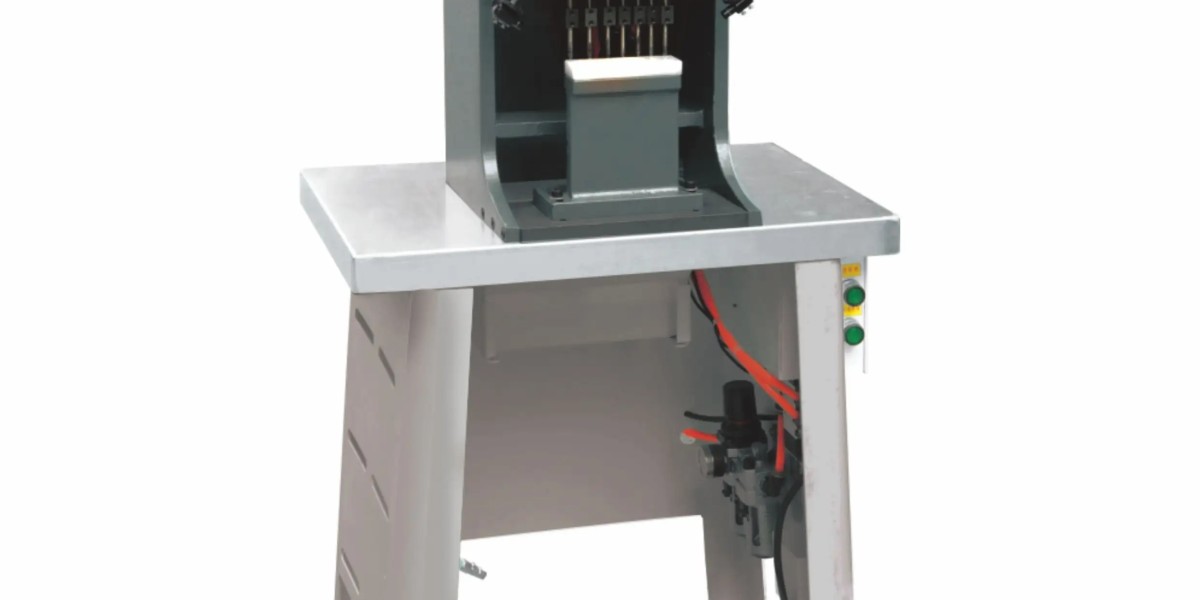
Punching machines round out this category of equipment, providing the capability to create clean holes in various materials before eyelet setting or for standalone purposes. The TH-703 Punching Machine represents this category, delivering precise, consistent holes in leather, fabric, and synthetic materials. Unlike cutting operations that remove material entirely, punching creates defined openings that must have clean edges and accurate positions. This precision is essential for ventilation holes in shoe uppers, drainage holes in sole structures, decorative perforations in fashion products, and the initial holes that will later receive eyelets or rivets.
Modern punching machines offer capabilities that extend far beyond simple round holes. Interchangeable punch and die sets allow operators to create square holes, oval shapes, slotted openings, or custom profiles matching specific design requirements. Programmable positioning systems enable complex patterns of multiple holes with precise spacing, supporting decorative perforation designs that would be impractical to execute manually. And depth control mechanisms allow partial punching for effects like embossing or for creating holes that penetrate only selected layers of multi-layer materials. This versatility makes punching machines valuable across multiple production stages, from initial component preparation to final decorative finishing.
The integration of these machines with other production equipment significantly affects overall efficiency. In well-designed factories, components flow from cutting and skiving to hole punching, then to eyelet or rivet setting, and finally to assembly, all without intermediate handling that could misalign parts or introduce delays. This continuous flow requires that machine capacities be matched and that workstations be positioned for smooth material transfer. When eyelet machines, riveting machines, and punching machines are sourced from the same trusted manufacturer, compatibility is assured and integration is simplified, allowing production engineers to focus on optimizing flow rather than resolving equipment mismatches.
Several factors deserve careful consideration when selecting eyelet, rivet, and punching equipment for a specific production environment. Material types and thicknesses determine the force requirements and tool designs needed for clean results. Production volumes influence whether manual-feed, semi-automatic, or fully automatic machines are most appropriate. Hardware sizes and styles affect tooling requirements and changeover frequency, with higher variety demanding more flexible machine configurations. Operator skill levels influence the complexity of controls and the amount of training needed for effective operation. And maintenance requirements affect long-term reliability, with well-designed machines allowing quick access to wear components and simple adjustment procedures that keep production running smoothly.
China has established itself as the global center for eyelet, rivet, and punching machine manufacturing through decades of continuous development and refinement. Chinese manufacturers have mastered the mechanical systems that power these machines, developing reliable feeding mechanisms, precise positioning controls, and durable setting heads that deliver consistent performance cycle after cycle. They have incorporated electronic controls that simplify operation while enabling sophisticated capabilities such as programmable patterns and automatic parameter adjustment. And they have built extensive sales and support networks that serve customers across multiple continents, ensuring that spare parts and technical assistance reach factories when needed. Companies like Guangdong Tenghong Machinery Technology Co., Ltd., located in Dongguan's thriving industrial region, exemplify this combination of technical capability and customer focus that has made Chinese hardware attachment machinery the preferred choice for footwear and leather goods producers worldwide.
The benefits of automatic eyelet, rivet, and punching equipment extend throughout the manufacturing operation in ways that compound over time. Consistent hardware placement eliminates the rework and rejects caused by misaligned or poorly set fasteners, reducing waste and improving first-pass yield. Faster cycle times increase production throughput, allowing the same labor force to produce more goods with the same equipment investment. Reduced operator fatigue improves quality during long production runs, as machines maintain consistency while human attention would naturally waver. And the professional appearance achieved with precision-set hardware enhances finished product quality, supporting premium pricing and strengthening brand reputation.
The relationship between hole quality and fastener performance deserves particular attention from manufacturers seeking optimal results. Even the finest eyelet or rivet cannot compensate for poorly punched holes, while precision holes enable even basic fasteners to perform at their best. Holes must be the correct size for the fastener, neither too tight which would stress the material nor too loose which would allow movement. Hole edges must be clean, without fraying or deformation that would compromise the fastener's grip. And hole positions must be accurate to ensure that assembled components align properly. When punching machines deliver consistently excellent holes, every subsequent operation benefits, from eyelet setting to final assembly.
Looking ahead, eyelet, rivet, and punching technology continues to evolve in response to manufacturer demands for greater efficiency, flexibility, and capability. Recent innovations include machines with vision-guided positioning that automatically adjusts for material stretch or pattern variations, ensuring accurate fastener placement even with challenging materials. Quick-change tooling systems reduce changeover times between different fastener sizes or hole shapes, enabling smaller batch sizes without sacrificing efficiency. Energy-efficient drive systems lower operating costs while maintaining the force needed for consistent setting. And integration with factory management systems provides real-time production data that supports continuous improvement efforts. These innovations ensure that hardware attachment technology will remain central to quality manufacturing for the foreseeable future.
For manufacturers considering investment in eyelet, rivet, or punching equipment, the decision carries implications that extend throughout the business. Improved attachment quality reduces field failures and the associated costs of returns and warranty claims. Faster processing speeds increase production capacity, supporting growth without proportional increases in floor space or labor. Reduced material waste lowers costs and supports sustainability goals that increasingly matter to consumers and regulators. And the consistent, professional appearance achieved with precision equipment strengthens brand positioning in increasingly competitive markets. In an industry where every detail matters, the finishing touch provided by quality hardware attachment equipment creates lasting competitive advantage.
Guangdong Tenghong Machinery Technology Co., Ltd., with its comprehensive range of eyelet machines, riveting machines, and punching machines, offers footwear and leather goods manufacturers the equipment and expertise needed to excel in these critical operations. Their machines combine the robust construction required for continuous industrial operation with the precision needed for consistent, professional results. Their team of experienced professionals understands the practical challenges of production floor management and provides the support that transforms equipment purchases into successful manufacturing capabilities. For any producer serious about quality, investing in superior hardware attachment technology is not an expense but an investment in market position, customer satisfaction, and long-term profitability.