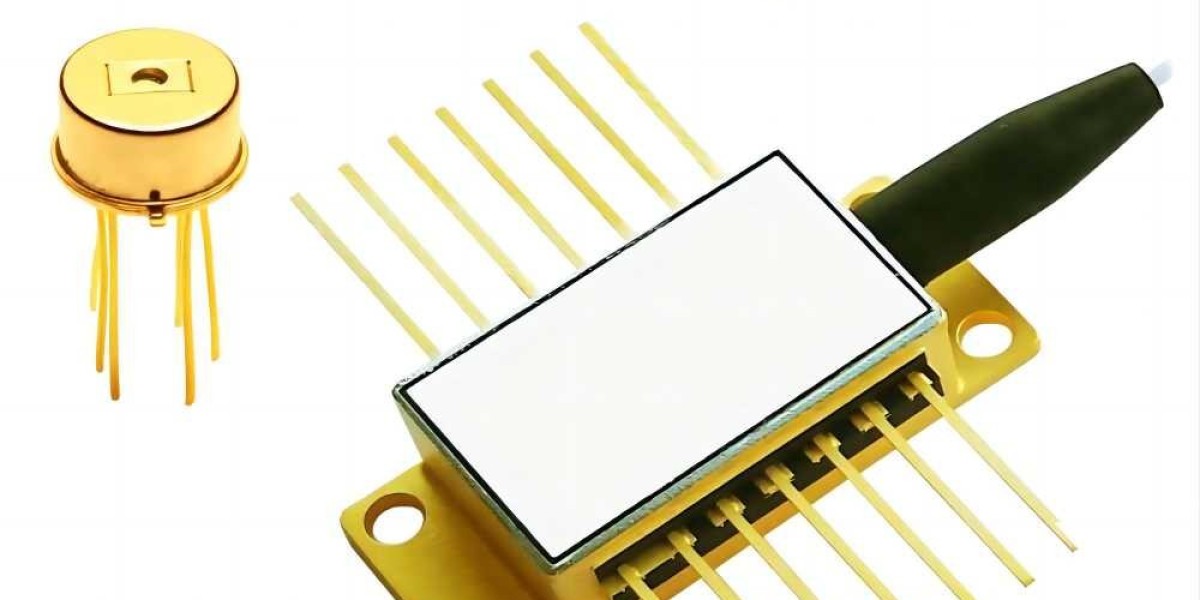

Microwave photonics is a specialized field that translates high-frequency Radio Frequency (RF) signals—ranging from a few gigahertz up to 30 GHz or more—onto an optical carrier for transmission over fiber optic cables. This technology is vital for applications requiring wide instantaneous bandwidth, immunity to electromagnetic interference (EMI), and lightweight cable infrastructure, notably in defense, satellite communications, and distributed antenna systems. The key enabling component in this domain is the microwave DFB laser, which must meet a uniquely stringent set of criteria far beyond those required for standard digital transmission.
Unlike digital lasers, which are judged by bit-error rates, a microwave DFB laser is judged by analog metrics: linearity, noise performance (Relative Intensity Noise or RIN), and the Spur-Free Dynamic Range (SFDR). The SFDR is a measure of the laser's ability to maintain a clear signal against the noise floor and the spurious signals generated by its own non-linearity. To achieve a high SFDR, the laser must possess low intrinsic noise and, critically, high linearity, meaning its optical output must be a perfect, proportional reflection of the electrical RF input signal. Any deviation introduces distortion that degrades the quality of the analog signal.
For most long-distance and high-performance analog links, the 1550nm DFB laser is the preferred choice for this demanding microwave DFB laser role. The selection of 1550 nm is strategic because it allows for seamless integration with high-performance optical amplifiers (EDFAs) and can leverage the lowest attenuation window of the fiber. Furthermore, these applications often require a high power DFB laser capability. The RF signal's quality is maximized when the optical signal power is high, effectively increasing the modulation depth without sacrificing the laser’s linearity. A higher optical power output directly translates to a better signal-to-noise ratio after detection at the receiver. Therefore, the most advanced microwave DFB lasers are typically robust, high-power, 1550 nm DFB sources.
The engineering challenges for these devices are immense. The laser packaging must incorporate meticulous impedance matching, often using high-frequency coaxial connectors (like SMA or 2.92mm), and integrated bias-T networks to couple the RF modulation signal onto the DC bias line without compromising signal integrity up to the K-band and beyond. The high power DFB laser must also incorporate advanced thermal management to dissipate heat generated during high-current operation, ensuring the DFB grating’s operation remains stable and the resulting spectral linewidth remains narrow. The performance of these specialized microwave DFB laser systems is a direct indicator of the capability of modern defense and telecommunications infrastructure, underscoring their critical and highly specialized position in the landscape of photonic components.