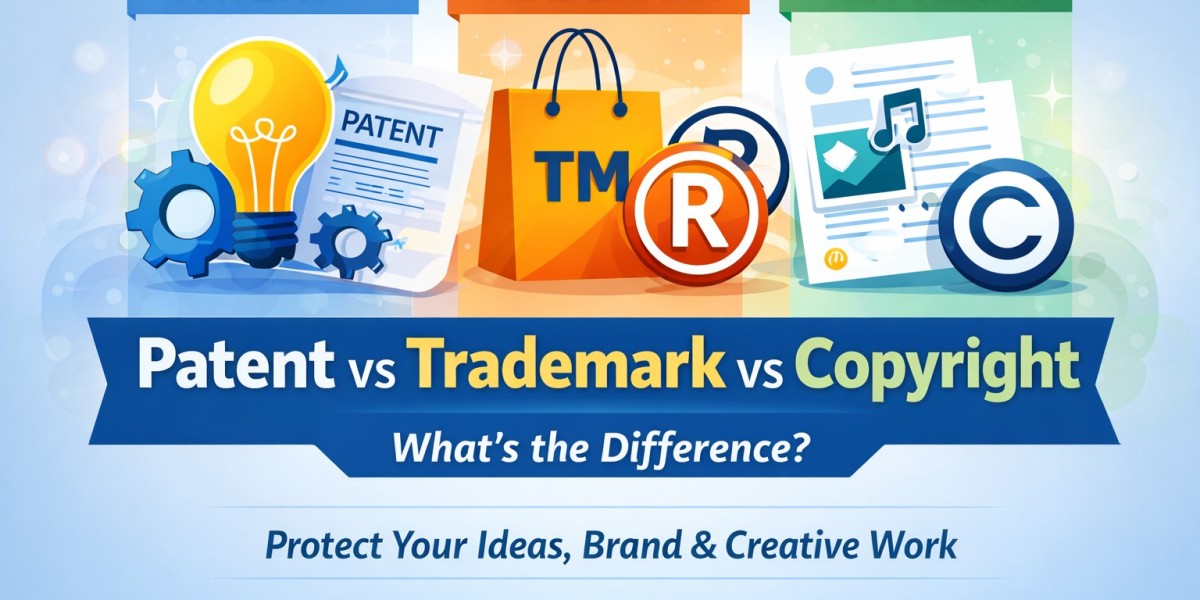

In today’s knowledge-driven economy, ideas, creativity, and brand identity are among the most valuable assets for individuals and businesses. Whether you are an entrepreneur, startup founder, artist, author, inventor, or business owner, protecting your intellectual property (IP) is essential. However, many people are confused about patents, trademarks, and copyrights—what they mean, how they differ, and which one applies to them.
This blog explains patent vs trademark vs copyright in a clear and practical way, helping you understand what each protects, how long protection lasts, and when you should apply for each.
What Is Intellectual Property?
Intellectual Property (IP) refers to creations of the mind such as inventions, brand names, logos, literary works, music, software, designs, and artistic expressions. IP laws grant creators exclusive legal rights over their creations to prevent unauthorized use or copying.
The three most common forms of IP protection are:
Patent
Trademark
Copyright
Each protects a different type of creation and serves a different legal purpose.
What Is a Patent?
A patent is a legal right granted to an inventor for a new invention. It gives the inventor exclusive rights to make, use, sell, or license the invention for a specific period.
What Can Be Patented?
New products or machines
Manufacturing processes
Technical innovations or improvements
Chemical compositions
Certain software-related inventions (with technical application)
To be patentable, an invention must be:
Novel (new)
Inventive (not obvious)
Capable of industrial application
Duration of a Patent
In India:
20 years from the filing date (for most patents)
Why Is a Patent Important?
Prevents others from copying your invention
Encourages innovation
Helps attract investors
Allows licensing and commercialization
Example
A new medical device, a unique engine design, or an innovative water-purification technology can be patented.
What Is a Trademark?
A trademark protects brand identity. It can be a name, logo, slogan, symbol, shape, or even a sound that distinguishes your goods or services from others.
What Can Be Trademarked?
Business or brand names
Logos and symbols
Taglines or slogans
Product packaging (trade dress)
Combination of colors or sounds
Duration of a Trademark
Valid for 10 years
Can be renewed indefinitely every 10 years
Why Is a Trademark Important?
Protects brand reputation
Builds customer trust
Prevents misuse of your brand name
Creates long-term business value
Example
Brand names like Tata, Nike, Zomato, and their logos are protected by trademark law.
What Is Copyright?
Copyright protects original creative works expressed in a tangible form. It arises automatically once the work is created and does not require mandatory registration, though registration provides legal proof.
What Is Protected Under Copyright?
Books, articles, and blogs
Music and sound recordings
Films and videos
Paintings, photographs, and artwork
Software and computer programs
Website content
Duration of Copyright
In India:
Lifetime of the author + 60 years
(for literary, artistic, musical, and dramatic works)
Why Is Copyright Important?
Protects creative expression
Prevents copying or unauthorized distribution
Enables creators to earn royalties
Encourages artistic and cultural growth
Example
A novel, YouTube video, mobile app code, or website content is protected by copyright.
Patent vs Trademark vs Copyright: Key Differences

The type of IP protection you need depends on what you want to protect:
You invented a new product or technology → Patent
You started a business or brand → Trademark
You created original content or art → Copyright
In many cases, businesses require multiple forms of IP protection. For example, a tech startup may patent its technology, trademark its brand name, and copyright its software code and website content.
Can One Creation Have Multiple IP Protections?
Yes. A single product or business can be protected under more than one IP law.
Example
A mobile app can have:
Patent for its unique technology
Trademark for the app name and logo
Copyright for the app’s code, design, and content
Importance of IP Protection for Businesses and Creators
Strong IP protection helps:
Prevent infringement and misuse
Increase brand value
Build market credibility
Generate revenue through licensing
Gain competitive advantage
In India’s growing startup and digital economy, intellectual property is often one of the most valuable business assets.
Common Myths About Patent, Trademark, and Copyright
Myth 1: Trademark and copyright are the same
Fact: Trademark protects brands; copyright protects creative content.
Myth 2: Registration is not important
Fact: Registration provides strong legal evidence and enforcement power.
Myth 3: Ideas are protected automatically
Fact: Only expressed or registered forms of ideas are protected.
Patent vs Trademark vs Copyright in India
India has a well-established IP framework governed by:
The Patents Act, 1970
The Trade Marks Act, 1999
The Copyright Act, 1957
With increasing awareness and digital growth, IP registration in India has become more accessible through online filing systems.
Conclusion
Understanding the difference between patent, trademark, and copyright is essential for protecting your intellectual assets. Each form of IP serves a unique purpose—patents protect inventions, trademarks protect brands, and copyrights protect creative expression.
Choosing the right protection at the right time can save you from legal disputes, financial losses, and brand dilution. Whether you are an innovator, entrepreneur, or creator, securing your intellectual property is not just a legal requirement—it is a smart business decision.
Original Post Content Sources Here: Patent, Trademark and Copyright Explained: Key Differences