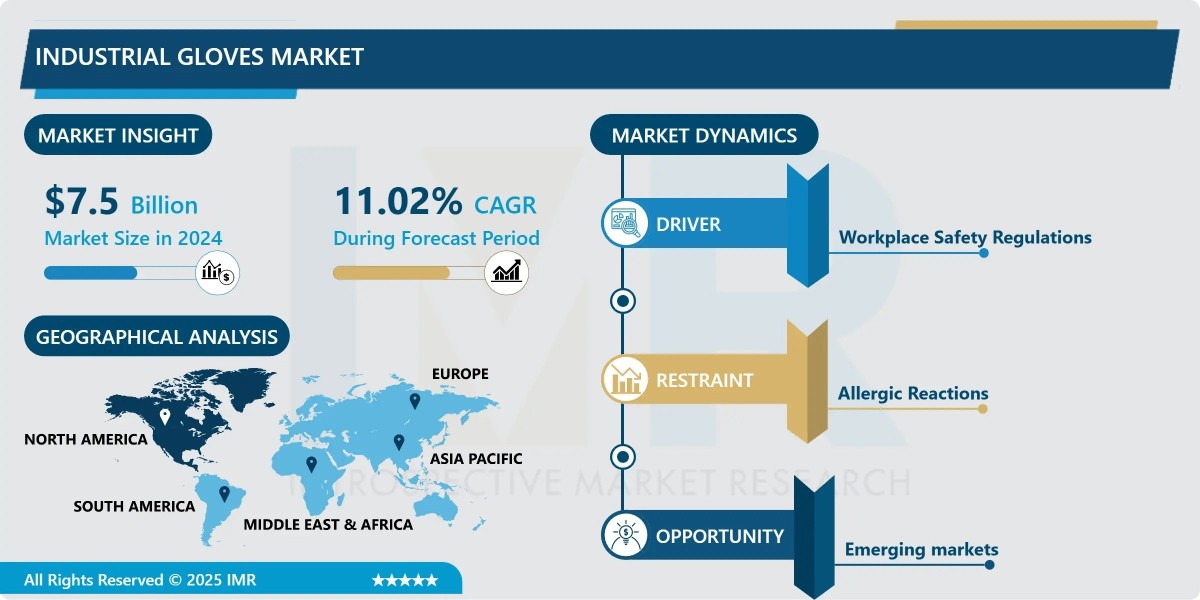

According to a new report published by Introspective Market Research, Industrial Gloves Market by Material Type, Product Type, End-User, and Region, The Global Industrial Gloves Market Was Valued at USD 11.02 Billion in 2024 and is Projected to Reach USD 19.65 Billion by 2032, Growing at a CAGR of 7.5%.
Market Overview:
The global Industrial Gloves market comprises personal protective equipment (PPE) designed to protect workers' hands from a wide range of occupational hazards, including chemicals, cuts, abrasions, heat, cold, and biological contaminants. Key products include disposable gloves (nitrile, latex, vinyl) and reusable gloves (made from materials like neoprene, butyl rubber, and cut-resistant fabrics). The primary advantage of modern industrial gloves over basic hand protection lies in their specialized engineering: they offer targeted resistance to specific risks, enhanced dexterity and comfort for prolonged wear, and compliance with stringent international safety standards, thereby reducing workplace injuries and improving productivity.
Growth Driver:
The foremost growth driver for the industrial gloves market is the global proliferation and tightening of occupational health and safety regulations, coupled with a heightened corporate focus on reducing workplace accidents and ensuring employee well-being. Governments and regulatory bodies worldwide are mandating the use of appropriate PPE in hazardous work environments. This regulatory push, exemplified by standards from organizations like OSHA (USA) and the European Agency for Safety and Health at Work (EU-OSHA), compels industries to procure certified gloves. Simultaneously, companies are proactively investing in safety to lower insurance costs, minimize downtime from injuries, and foster a responsible corporate culture. This dual pressure from regulators and internal risk management creates sustained, non-discretionary demand for industrial gloves across all sectors.
Market Opportunity:
A significant and growing market opportunity lies in the development of smart, sensor-integrated gloves and sustainable material innovations. The next generation of industrial gloves can incorporate sensors to monitor environmental exposure (e.g., chemical concentration, temperature), track worker fatigue, or even provide haptic feedback for training and precision tasks in manufacturing. Furthermore, there is immense potential in creating high-performance gloves from bio-based, biodegradable, or recycled materials to address environmental concerns around disposable glove waste. Developing gloves that offer superior protection while enhancing dexterity and comfort for specialized applications—such as in microelectronics assembly or automotive painting—also represents a high-value niche, allowing manufacturers to move beyond commoditized competition and capture premium market segments.
Industrial Gloves Market, Segmentation
The Industrial Gloves Market is segmented on the basis of Material Type, Product Type, and End-User.
Material Type
The Material Type segment is further classified into Natural Rubber/Latex, Nitrile, Vinyl, Neoprene, and Others. Among these, the Nitrile sub-segment accounted for the highest market share in 2024. Nitrile gloves dominate due to their superior puncture and chemical resistance compared to latex and vinyl, absence of allergy risks associated with latex proteins, and excellent durability. They have become the material of choice across healthcare, automotive, chemical, and manufacturing sectors, effectively balancing performance, safety, and cost, which drives their widespread adoption and market leadership.
End-User
The End-User segment is further classified into Healthcare, Manufacturing, Automotive, Chemical, Food & Beverage, and Others. Among these, the Healthcare end-user segment accounted for the highest market share in 2024. While including non-sterile medical examination gloves, this segment's dominance is fueled by the massive, consistent volume use in hospitals, clinics, laboratories, and long-term care facilities. The pandemic permanently elevated baseline usage, and ongoing focus on infection control protocols, coupled with the global expansion of healthcare infrastructure, ensures this segment remains the largest consumer of disposable industrial gloves.
Some of The Leading/Active Market Players Are-
- Top Glove Corporation Bhd (Malaysia)
• Hartalega Holdings Berhad (Malaysia)
• Ansell Limited (Australia)
• Supermax Corporation Berhad (Malaysia)
• Kossan Rubber Industries Bhd (Malaysia)
• Honeywell International Inc. (USA)
• 3M Company (USA)
• Kimberly-Clark Corporation (USA)
• MCR Safety (USA)
• Showa Group (Japan)
• Lakeland Industries, Inc. (USA)
• Riverstone Holdings Limited (Singapore)
• UVEX Safety Group (Germany)
• MAPA Professional (Germany)
• Cardinal Health, Inc. (USA)
• and other active players.
Key Industry Developments
News 1:
In February 2024, Ansell launched a new line of "HyFlex®" cut-resistant gloves with integrated IoT sensors that alert supervisors when the glove material has been compromised or when a worker experiences excessive hand fatigue, aiming to prevent injuries proactively in manufacturing settings.
News 2:
In January 2024, Top Glove announced a major investment in developing gloves made from a new bio-based, biodegradable polymer derived from sugarcane. This initiative targets the growing demand for sustainable PPE and aims to reduce the environmental impact of disposable glove waste in sectors like food service and light industrial work.
Key Findings of the Study
- Nitrile gloves are the dominant material type, favored for their durability, chemical resistance, and latex-free properties.
• The Asia-Pacific region leads the market, driven by high manufacturing output and being the production hub for major glove manufacturers.
• Stringent global occupational safety regulations and rising workplace safety awareness are the primary growth drivers.
• Key trends include the shift towards nitrile over latex, the development of sustainable and smart gloves, and growing demand from the healthcare and electronics manufacturing sectors.