
Accounts payable is one of those business functions that quietly grows more complex over time. What starts as simple invoice processing can quickly turn into a bottleneck involving approvals, compliance checks, vendor queries, and cash flow pressure. As companies scale, a common question emerges: Is it more cost-effective to keep AP in-house or switch to outsourced accounts payable services?
Let’s break this down from a real-world business perspective—looking beyond salaries and into efficiency, risk, scalability, and long-term cost impact.
Understanding In-House Accounts Payable
In-house AP teams handle invoice intake, data entry, approvals, vendor payments, reconciliations, and reporting. For smaller organizations with low invoice volumes, this setup can work reasonably well.
However, as the business grows, in-house AP often faces challenges such as:
Increasing invoice volumes without added resources
Manual processing and approval delays
Higher risk of duplicate or late payments
Limited visibility into outstanding liabilities
While having an internal team offers direct oversight, it also introduces fixed costs and operational rigidity.
The True Cost of Managing AP Internally
The cost of in-house AP goes far beyond employee salaries. Businesses often overlook indirect and hidden expenses that accumulate over time.
These costs include:
Recruitment, onboarding, and training
Payroll taxes, benefits, and paid leave
AP software licenses and system maintenance
Time spent fixing errors and resolving vendor disputes
Audit preparation and compliance reviews
When invoice volume increases, companies typically respond by hiring more staff—raising fixed costs regardless of seasonal or transactional fluctuations.
What Are Accounts Payable Services?
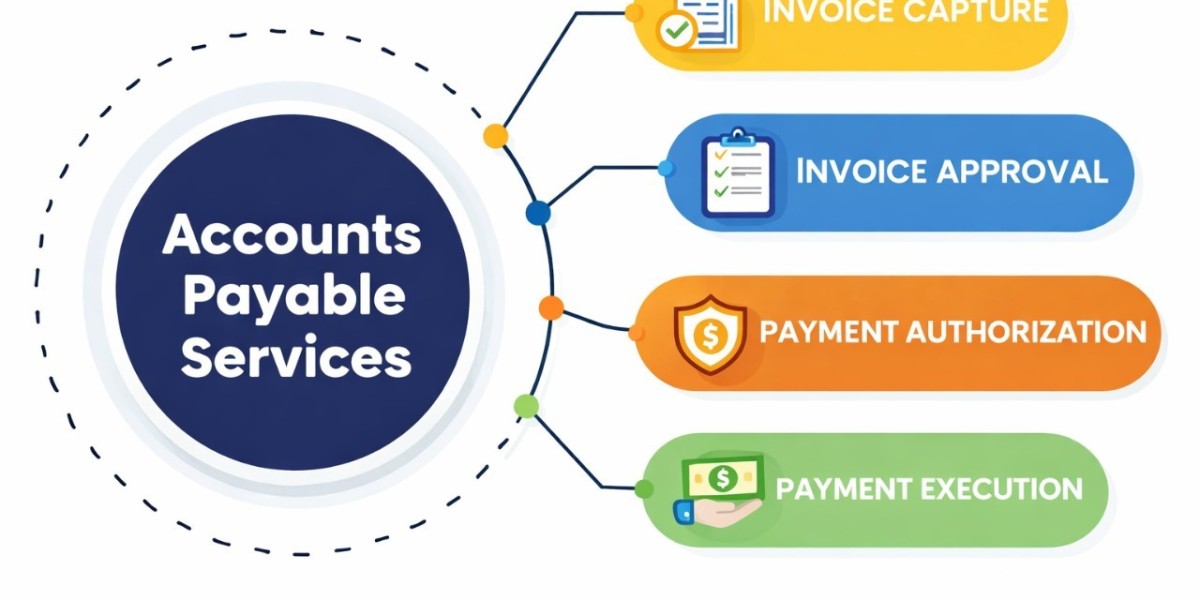
Accounts payable services involve outsourcing AP functions to a specialized provider that uses standardized processes, trained professionals, and automation tools to manage the entire AP cycle.
These services usually cover:
Invoice receipt and data capture
Approval workflow coordination
Vendor payment processing
Reconciliations and AP reporting
Instead of building internal capacity, businesses rely on a dedicated team that handles AP efficiently and consistently.
Cost Predictability with Outsourced AP
One of the biggest advantages of outsourced AP is predictable cost structure. Unlike in-house teams, outsourced models scale with transaction volume—not headcount.
With outsourced accounts payable services, businesses benefit from:
Lower overhead and no long-term staffing commitments
Flexible pricing aligned with workload
Reduced investment in AP technology
No recruitment or training expenses
This makes outsourcing especially attractive for growing companies looking to control operating costs.
Efficiency and Speed: Where Outsourcing Wins
Manual invoice processing is slow. Approvals get stuck in inboxes, data entry errors occur, and payment cycles stretch longer than necessary.
Outsourced AP providers streamline processes using automation and defined workflows, resulting in:
Faster invoice processing
Shorter approval cycles
On-time vendor payments
Improved cash flow visibility
Speed and efficiency reduce operational friction—and fewer delays mean fewer late fees and stronger vendor relationships.
Error Reduction and Compliance Control
Errors in accounts payable can be expensive. Duplicate payments, incorrect amounts, or missed approvals directly impact profitability and audit readiness.
Outsourced AP services reduce these risks by implementing:
Multi-level quality checks
Standardized approval controls
Clear audit trails and documentation
Segregation of duties
This structured approach significantly lowers the risk of compliance issues, internal control failures, and audit findings.
Technology Access Without High Investment
Modern AP functions rely on automation, OCR, and digital approval workflows. Implementing these systems in-house often requires high upfront costs and ongoing maintenance.
Outsourced providers give businesses access to:
Automated invoice capture
Digital approval workflows
Real-time AP dashboards
Secure document management
This technology improves accuracy and visibility—without the burden of managing systems internally.
Scalability: The Key Cost Advantage
In-house AP teams are difficult to scale quickly. Growth usually means hiring, training, and managing more staff. During slow periods, fixed costs remain.
Outsourced AP services offer flexibility by:
Scaling support up or down as needed
Handling seasonal invoice spikes
Supporting business expansion without delays
This scalability makes outsourcing more cost-effective for companies experiencing growth or variability in transaction volume.
Which Option Is More Cost-Effective?
So, which is truly more cost-effective—in-house AP or outsourced accounts payable services?
In-house AP may be suitable for small organizations with limited invoice volume and minimal complexity. But as businesses grow, hidden costs, inefficiencies, and risks increase.
Outsourced AP is typically more cost-effective for companies that:
Process high or fluctuating invoice volumes
Need faster, more accurate AP cycles
Want stronger compliance and controls
Prefer variable costs over fixed overhead
The decision isn’t just about cost—it’s about long-term operational efficiency and financial control.
Conclusion
When comparing accounts payable services vs in-house AP, cost-effectiveness goes beyond salaries and software. It includes efficiency, accuracy, compliance, scalability, and the ability to support growth without operational strain.